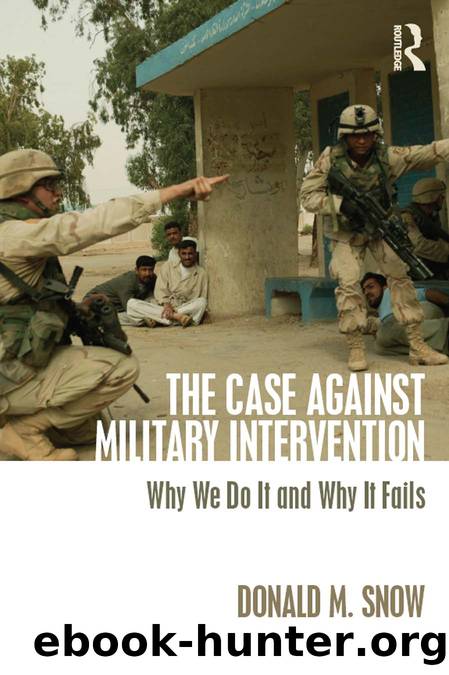
The Case Against Military Intervention: Why We Do It and Why It Fails by Donald M. Snow
Author:Donald M. Snow [Snow, Donald M.]
Language: eng
Format: epub
Tags: International Relations, Political Science, General
ISBN: 9780765647559
Google: 1_ksCgAAQBAJ
Goodreads: 26266353
Publisher: Routledge
Published: 2015-07-23T00:00:00+00:00
Unpalatable Menu Choices
The problem facing the American national security policy and execution should be becoming clear by now. Shorn of the organizational and conceptual security blanket of the Cold War but without a successor paradigm to guide its actions, the United States has floundered twice since the end of the Cold War into major military actions that were unfortunate and ill-advised. In Vietnam, it misapplied its principles with the same outcome. All have failed or are, certainly in a political sense, in the process of reaching conclusions that do not meet American expectations expressed in the political objectives for which they were undertaken. The records of the two post-Cold War forays are not identical, and neither is the same as Vietnam. What draws them together is they were entirely predictable American failures. Recognizing why they did not and could not succeed is the key to avoiding repetition of the same mistakes in the future.
All were, or became, unwinnable wars of choice. There would have been no war in Iraq in 2003 had the United States not started one, and the fact of American instigation is the unique contextual setting of that situation. If the goal was to disassemble the old Iraq and replace it with something better, it was partially a success: the Saddam Hussein regime fell, but the process of creating a better successor remains, charitably, a work in progress. Less charitably, Iraq is in the process of moving from a Sunni dictatorship to a Shiite autocracy or breaking apart into separate Sunni, Shiite, and Kurdish states. Anyone who finds this evolution surprising simply has not paid attention to the regionâs history. Where it will lead is anyoneâs guess; that it will not end up the way the United States hoped is probably as close to a given as we have.
Afghanistan is built from the same fabric. What might be called the American Afghan War Part I (the campaign to capture Al Qaeda) was at least an arguable war of necessity that could have been won had it been competently led and conducted. It was not, and so it failed. The greater problem and lesson surrounds the American Afghan War Part II, which has pursued the feckless goal of creating a stable, strong, anti-Taliban central government in Kabul, a goal the Afghan people either do not share in principle or at least do not desire under the current, American anointed and blessed regime. Vietnam, by contrast, was at heart a war of nationalism where the United States ended up on the wrong side of the Vietnamese desire to be united as one country, quite regardless of the ideology of the liberators.
These kinds of morasses occur when a country, in this case the United States, involves itself in unstable developing world internal conflicts (DWICs) with armed forces. The underlying dynamics of these situationsâparticularly when outsiders like the United States become involvedâare quite similar and lead to similar outcomes. This statement of the dynamics is intended to be cautionary, because in
Download
This site does not store any files on its server. We only index and link to content provided by other sites. Please contact the content providers to delete copyright contents if any and email us, we'll remove relevant links or contents immediately.
Spell It Out by David Crystal(36255)
Life for Me Ain't Been No Crystal Stair by Susan Sheehan(35917)
The Great Music City by Andrea Baker(34019)
Cecilia; Or, Memoirs of an Heiress — Volume 1 by Fanny Burney(32747)
Cecilia; Or, Memoirs of an Heiress — Volume 2 by Fanny Burney(32110)
Cecilia; Or, Memoirs of an Heiress — Volume 3 by Fanny Burney(32091)
Professional Troublemaker by Luvvie Ajayi Jones(29784)
The Secret History by Donna Tartt(19511)
We're Going to Need More Wine by Gabrielle Union(19233)
Twilight of the Idols With the Antichrist and Ecce Homo by Friedrich Nietzsche(18794)
All the Missing Girls by Megan Miranda(16830)
Cat's cradle by Kurt Vonnegut(15586)
For the Love of Europe by Rick Steves(14998)
Pimp by Iceberg Slim(14821)
Bombshells: Glamour Girls of a Lifetime by Sullivan Steve(14241)
Norse Mythology by Gaiman Neil(13660)
Talking to Strangers by Malcolm Gladwell(13578)
Fifty Shades Freed by E L James(13374)
The Social Justice Warrior Handbook by Lisa De Pasquale(12311)
